

How IRA Millionaires escape a lifetime of unnecessary income tax
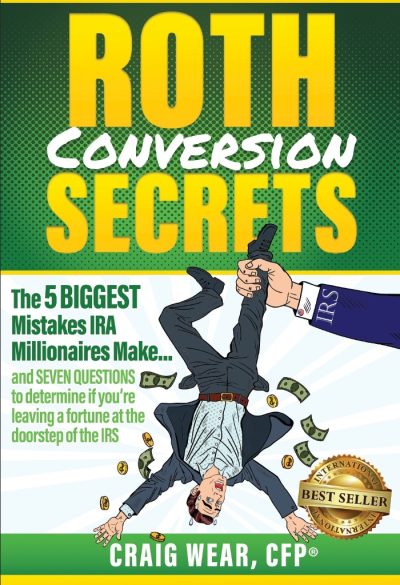
The 5 costliest Roth conversion mistakes, and the 7 questions that tell you whether you’re leaving a fortune at the doorstep of the IRS.
Full-color PDF, in your inbox in minutes. No shipping. No subscription.
Craig explains, in about four minutes, why the advice most IRA Millionaires are given is technically correct and financially expensive. Captions on by default.
A good portion of that account was never yours.
If you have a million dollars or more in an IRA or 401(k), there is something worth knowing before you read another word.
I realize now that that’s not our $3,000,000 sitting there. A good portion of that belongs to Uncle Sam.
He was right. He worked it out at seventy.
That’s what this book is about. Not a product and not a projection. A method for finding out, with actual numbers and in a single afternoon, whether the account you spent forty years building has a tax problem inside it, and how large that problem is.
Here is the uncomfortable part. Most people who read this book discover they’ve been given advice that is technically correct and financially expensive. Their CPA told them to convert to the top of their current tax bracket. That sounds prudent. In our analysis it is the single most expensive mistake an IRA Millionaire can make.
Converting to the top of your bracket can leave you further behind than doing nothing.
| In one year | Convert $80,000 to the top of the 22% bracket | Convert $100,000 more than your CPA suggested |
|---|---|---|
| IRA growth at 5% | +$60,000 | +$60,000 |
| Amount converted | −$80,000 | −$100,000 |
| Net change in the IRA | −$20,000 | −$40,000 |
You converted, you paid the tax, and the account barely moved. Even converting more than you were told to barely dents it. That is what “never convert into a higher bracket” costs an IRA Millionaire.
Chapter 8 follows a couple who did it the other way, seven years of conversions at a materially higher bracket. They avoided close to $1.8 million. Against the conventional current-bracket plan, the difference was $1.3 million.
The deadline was never Congress. It’s your own balance.
Your balance is compounding
A $2,000,000 IRA growing at 6% adds about $120,000 a year. Converting to the top of the 22% bracket moves roughly $6,700 of it. You didn’t get ahead. You fell behind by $113,300 and paid tax for the privilege.
RMDs begin at 73
Every year between now and then is a conversion year you either used or spent. Afterward the amount is calculated for you, added to your income, and grows every year for the rest of your life.
The date nobody schedules
When one spouse dies, the survivor files as a single taxpayer on roughly the same income. Same money, worse brackets, permanently. Nobody plans for this one, which is exactly why it does so much damage.
Permanent rates removed the excuse to hurry. They did not remove the reason.
And what we won’t claim.
families worked with
projected lifetime tax avoidance
years specializing in this one problem
conversations with IRA Millionaires
Now the honest part. That $10 billion is a projection built from individual client analyses, not a bank statement. Results depend on your age, your balance, your income, your state, and whether you act.
A more useful number for you: across the families we work with, the gap between the strategy their advisor proposed and the optimal strategy typically runs into six and seven figures over a lifetime. In the case study inside this book, that difference was $1.3 million, not between converting and not converting, but between converting the conventional way and converting the optimal way.
Two lists, and the arithmetic behind both.
The 5 most expensive mistakes
- Converting only to the top of your current bracket
- Throttling conversions to stay under the Medicare threshold
- Stopping short so this year’s Social Security isn’t taxed
- Leaving a plan that makes the IRS a significant heir
- Leaving charitable intent out of the conversion plan
The 7 defining questions
Seven questions you answer for yourself, about future rates, how much of your income actually comes from these accounts, what your lifetime RMDs will be, what they do to your Social Security and your Medicare premiums, what you intend for heirs and charity, and whether converting makes your retirement plan more or less likely to work.
If the answers point one way, you’re leaving a fortune sitting at the doorstep of the U.S. Treasury. If they point the other, you’ll know why, and you can stop wondering.
Your 401(k) wasn’t a mistake
But the thing that made it smart during your working years is what makes it expensive now.
Getting at converted funds
The five-year rule is widely misunderstood. Over 59½, converted principal is available immediately.
Moving the portfolio
Which assets to convert first, and why sequencing can put an extra $100,000 of growth assets into the Roth each year.
Four things you’re probably thinking.
“I need to run this past my CPA.”
Please do. Most of our clients bring their CPA into the process and we encourage it. But ask one specific question, because it’s the one nobody is measured on:
“Across my remaining lifetime, my spouse’s, and the ten years our children have to empty whatever is left: what do we pay in total federal income tax if we change nothing?”
Your CPA isn’t wrong. Your CPA is filing last year’s return. Nobody has asked them to model the next thirty.
“I can do this myself.”
You probably can. Several of our clients built better spreadsheets than the ones we started with. The question isn’t capability, it’s two other things.
First: is this what you want to spend your sixties doing? Second, and this is the one that matters: recharacterization went away in 2018. Once you convert, that tax year is closed. There is no undo button.
You’ll do this once. We’ve done it several thousand times.
“I’m 74. Haven’t I missed the window?”
The most common question we get, and the answer surprises people. A Roth conversion stops being a bet on your lifespan the moment you stop measuring it inside your lifetime.
At 74, your heirs are subject to the ten-year rule. That’s ten-year math, not thirty-year math, and it usually makes the case stronger, not weaker.
One client put it better than I can: “Everybody’s good climbing the mountain. Too many people die coming down the mountain.”
“I’m talking to a couple of other firms.”
Good. Ask all of us the same three questions:
What do you charge, and does the fee change based on how much I move? Do you take custody of any of my assets? And will you show me your assumptions, or only your conclusion?
We charge a flat fee, we never hold a dollar of your money, and the assumptions are printed in the book.

Questions
Before you buy
Does this still apply now that the 2017 tax rates were made permanent?
More than before. Permanent rates removed the deadline, not the problem. Your IRA keeps compounding, RMDs still begin at 73, and the surviving spouse still files as a single taxpayer. What changed is that you now have time to do this properly instead of in a panic, which is exactly the window most people waste.
I’m already doing conversions on my own. Is there anything here for me?
This is the most common profile among our readers. Nearly a third of the people who come to us are already converting, and the most expensive mistake in this book is the one self-directed converters make most often: stopping at the top of the current bracket. Chapter 5 is written for you specifically.
I have less than $1 million. Should I still read it?
Read the opening of Chapter 5 first. It lists the four situations where accelerated conversion likely doesn’t make sense, and a permanently low bracket is one of them. If that’s you, the book will tell you so, and you’ll have your answer for $3.95.
Will a Roth conversion raise my Medicare premiums?
Possibly, and temporarily. One of the costliest mistakes in the book is throttling conversions to stay under the surcharge threshold and paying far more in lifetime tax as a result. The book shows why crossing IRMAA for a few years often ends a lifetime of it.
Why is the book only $3.95? What’s the catch?
There isn’t one. We don’t run recurring programs, we don’t sell financial products, and we don’t manage money. The book is priced to be read. If it’s useful, some readers eventually ask us to build their plan, that’s the entire business model, and it’s a flat fee.
Find out what your IRA actually costs you.
$3.95. Full-color PDF. In your inbox in minutes.
Q3 Advisors, LLC is a Registered Investment Advisor. Information on this page is for educational purposes only and does not constitute tax, legal or investment advice, nor a recommendation regarding any specific security or strategy. Roth conversion outcomes depend on individual circumstances including age, account balances, income, filing status and state of residence. Projected figures are modeled estimates based on client analyses and are not a guarantee of future results. Inherited assets are free of federal income tax; six states levy a separate inheritance tax. Consult your own tax professional before acting.