

The rules changed. Most IRA Millionaires are still playing the old ones.
What to do differently now that the 2017 rates are permanent, RMDs start at 73, and the SECURE Act has rewritten what your children inherit.
If you’ve got a million or more sitting in an IRA or 401(k) and you’re between 59 and 73, this is written for you.
Full-color PDF, in your inbox in minutes. No shipping. No subscription.
Craig on what changed in 2025, and why permanent tax rates make the case for converting stronger rather than weaker. Captions on by default.
Everyone treated 2025 as a deadline. Then the deadline was removed.
Rates dropped
The TCJA cut brackets and set an expiry date of 31 December 2025.
The expiry was cancelled
Those rates were made permanent. Most people read that as permission to wait.
RMDs begin
Every year until then is a conversion year you either used or spent. After it, the amount is calculated for you.
One of you files single
Same income, single brackets, permanently. Nobody plans for this one, which is why it does so much damage.
Permanent rates removed the excuse to rush. For most people they replaced it with an excuse to do nothing.
First, let me concede the strongest argument against me.
| IRA today | $1,000,000 |
| Tax at 30%, paid now | −$300,000 |
| Into the Roth | $700,000 |
| Grows 12 yrs at 6% | ×2 |
| You keep, income-tax-free | $1,400,000 |
| IRA today | $1,000,000 |
| Grows 12 yrs at 6% | $2,000,000 |
| Tax at 30%, paid later | −$600,000 |
| You keep, after tax | $1,400,000 |
Identical. The rate arbitrage everyone argues about produces exactly nothing, as long as the rate is the same.
But Path B doesn’t end there. That $2,000,000 must distribute income to you from 73 whether you need it or not. Those distributions push more of your Social Security into taxable territory and raise your Medicare premiums for life. Whatever’s left lands on your children under a ten-year rule, usually in their highest-earning decade.
The tax you paid is the same. Everything that happens after it is not.
In one of the cases in this book, the couple who converted aggressively ended with zero lifetime RMDs and paid over $100,000 less in Medicare premiums than the couple who converted conservatively in order to protect their Medicare premiums.
And the better version of each.
| You’ve been told | The better question |
|---|---|
| “Never convert into a higher tax bracket.” | A $2M IRA at 6% adds $120,000 a year. Converting to the top of 22% moves about $6,700 of it. You didn’t get ahead. You fell behind $113,300 and paid tax for it. |
| “Wait, you’ll be in a lower bracket later.” | In a client’s own words: “Everybody tells you to wait. Your taxes will be lower. But guess what? Our taxes are more.” RMDs plus Social Security plus a pension routinely produce a higher bracket at 75 than at 65. |
| “Don’t cross the Medicare threshold.” | IRMAA is real and it will cost you. The question is whether you pay it for four years or the next twenty-five. Backing off to protect this year’s premium is stepping over dollars to pick up dimes. |
| “Don’t convert if you’re already in a high bracket.” | If you’re in a high bracket now with a large IRA, your RMDs will put you in a higher one later. That’s an argument for moving faster, not slower. |
| “It’s too late once RMDs start.” | RMDs reduce your options; they don’t eliminate them. If your goal has shifted from your own taxes to what your children inherit, the case at 75 is often stronger than at 65: ten-year math, not thirty-year math. |
The conversion, and everything that plugs into it.
The conversion itself
A five-step multi-year plan: current bracket, annual targets, Medicare and Social Security interactions, market timing, annual review. Plus the rules of thumb: convert more, sooner, and measure lifetime tax rather than this year’s.
The SECURE Act, correctly
RMDs at 73 today and 75 from 2033. The ten-year rule and what it does to your children. And the change most people missed entirely: Roth 401(k)s no longer require lifetime distributions.
Charitable giving
Donor-advised funds and qualified charitable distributions, and how each one interacts with a conversion year. Worked cases with real AGI numbers, including how a DAF gift offsets a $300,000 conversion.
Estate and trusts
A working reference on revocable, irrevocable, marital, charitable-remainder and dynasty trusts, plus the one distinction that actually governs an inherited IRA: conduit versus accumulation.
Investments in transition
Which assets to move first and why. If it’s going to grow, you want it growing inside the Roth, and sequencing decides how much growth gets there.
Choosing an advisor
Including a section titled “Fiduciary standard is not the best question.” Craig explains what to ask instead, and why a great generalist is still a generalist.
Is this book for you?
Written for you specifically
With roughly $1,000,000 or more in pre-tax savings, you’re in the years where the arithmetic works hardest and the decisions are still entirely yours.
Your question has changed
It’s no longer “how much tax will I pay?” It’s “who’s holding the bill when I’m gone?” Start with Chapters 2 and 9. That case is frequently stronger, not weaker, breakeven is a fifty-five-year-old’s question.
Different mechanics
If you hold substantial savings outside the IRA, the five-year rules and the penalty on using IRA funds to pay conversion tax both matter more for you. Chapter 4.
Under ~$500,000, or a permanently low bracket
This book will most likely tell you not to bother. That’s a legitimate answer, and it’s worth $3.95 to stop wondering.
Three things you’re probably thinking.
“I’ll ask my advisor.”
Do. But ask something specific, because it’s the question nobody is measured on: across my remaining lifetime, my spouse’s, and the ten years our children have to empty whatever’s left: what do we owe in total federal income tax if we change nothing?
Chapter 10 has a couple in their sixties with $3,000,000 in IRAs whose advisor proposed converting $50,000 a year to stay under 22%. At that pace it would have taken sixty years. He wasn’t a bad advisor. He was answering a different question.
“I can run this myself.”
Many of our readers can, and some do it well. Two things to weigh.
Recharacterization was eliminated in 2018. Once you convert, that tax year is closed and there is no undo.
And as one client put it: “It’s not what I know. It’s what I don’t know I don’t know.”
“Am I too old for this to pay off?”
A Roth conversion stops being a bet on your lifespan the moment you stop measuring it inside your lifetime.
If your money is going to outlive you, the relevant math is the ten-year rule your heirs face, not your own life expectancy. “Everybody’s good climbing the mountain. Too many people die coming down the mountain.”

Questions
Before you buy
The rates are permanent now. Doesn’t that make this book obsolete?
The opposite. This is the only one of Craig’s three books written after the SECURE Act changes and it is the only one that is current on RMD ages and the Roth 401(k) rules. What permanence changed is the reason to act: no external deadline, but the same compounding balance and the same two personal dates. Chapter 3 is about what to do with a window that no longer closes on its own.
I already read Roth Conversion Secrets. Is this different?
Substantially. Secrets is about the conversion decision itself, the mistakes and the questions. Reset spends most of its pages on material that isn’t in Secrets at all: the SECURE Act, the behavioral reasons people delay, donor-advised funds and QCDs, trusts and estate integration, and the pay-now-versus-later proof above.
Does the book cover what my children will actually owe?
Yes. Chapter 4 on the ten-year rule and Chapter 9 on trusts, including the conduit-versus-accumulation distinction that decides how an inherited IRA is actually taxed. Note that inherited assets are free of federal income tax; six states levy a separate inheritance tax.
I’m already converting on my own. Anything here for me?
Nearly a third of the people who come to us are already converting. The chapters on pacing, investment sequencing and charitable integration are the ones self-directed converters most often tell us they hadn’t considered.
Why only $3.95? What’s the catch?
None. No recurring program, no financial products, no asset management. The book is priced to be read. If it’s useful, some readers eventually ask us to build their plan. That’s a flat fee, and it’s the whole business model.
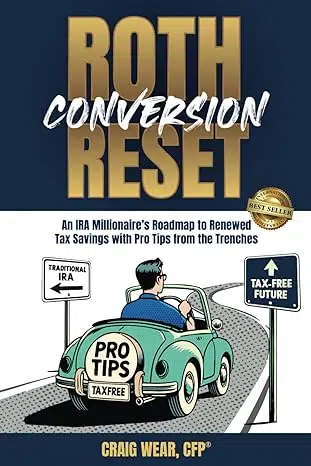
Get the current book.
$3.95. Full-color PDF. In your inbox in minutes.
Q3 Advisors, LLC is a Registered Investment Advisor. Information on this page is for educational purposes only and does not constitute tax, legal or investment advice. Roth conversion outcomes depend on individual circumstances including age, account balances, income, filing status and state of residence. Projected figures are modeled estimates based on client analyses and are not a guarantee of future results. Tax law referenced reflects rules in effect as of publication; consult your own tax professional before acting.