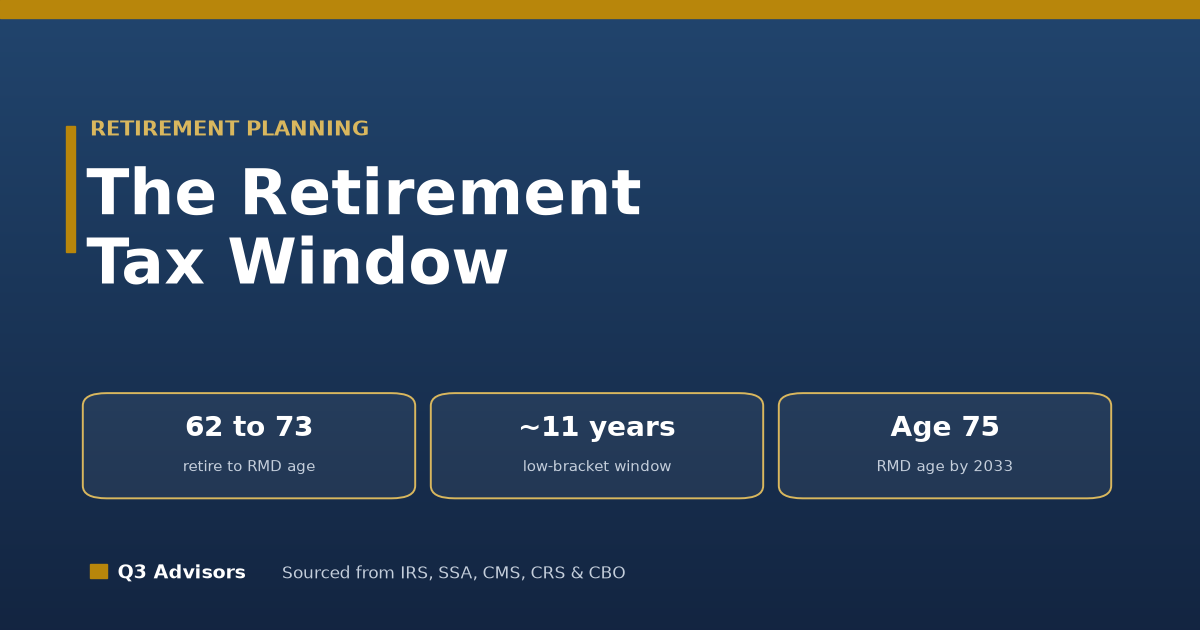
The RMD age is 75 for anyone born in 1960 or later under SECURE 2.0, while people born 1951 through 1959 keep age 73.
Key Takeaways
- Age 75 is the RMD age for individuals born on or after January 1, 1960, under Section 107 of the SECURE 2.0 Act of 2022.
- Individuals born from 1951 through 1959 use age 73, effective 2023.
- The first age 75 RMDs occur in 2035, never 2033.
- The RMD age moved from 70.5 to 72 under the SECURE Act of 2019, then to 73 in 2023 and 75 in 2035.
- A missed RMD triggers a 25% excise tax under Internal Revenue Code Section 4974, reduced to 10% if corrected within two years using Form 5329.
- IRS Publication 590-B is the primary source covering RMD rules and the Uniform Lifetime Table.
RMD Rules by the Numbers
Figures from IRS Publication 590-B and the SECURE 2.0 Act of 2022.
The IRS required minimum distributions age of 75 under SECURE 2.0 applies to anyone born in 1960 or later, and the official primary source is IRS Publication 590-B. People born from 1951 through 1959 keep the age-73 rule. This page confirms which age governs your birth year, when the age-75 rule actually starts, and cites the IRS and the Congressional Research Service so you can verify every figure.
Age 75 is the required minimum distribution (RMD) age for individuals born on or after January 1, 1960, under Section 107 of the SECURE 2.0 Act of 2022. Individuals born from 1951 through 1959 use age 73. The first age-75 RMDs occur in 2035. Source: IRS Publication 590-B and the IRS required minimum distributions FAQs.
What is the RMD age for someone born in 1960 or later?
The RMD age for someone born in 1960 or later is 75, set by the SECURE 2.0 Act of 2022 and reflected in IRS Publication 590-B. A required minimum distribution is the minimum amount the owner of a traditional IRA, SEP IRA, SIMPLE IRA, or employer retirement plan must withdraw each year once reaching the applicable age. A Roth IRA has no RMD during the owner’s lifetime.
The age is set by federal statute and keyed to your date of birth, not the year you retire. For a 2026 walkthrough of the calculation and deadlines, see the Q3 Advisors guide to required minimum distributions in 2026.
Talk With Craig Wear's Team
Craig has helped IRA millionaires save over $1 million each in unnecessary taxes. Find out if a Roth conversion strategy fits your retirement, with no sales pressure and no product pitch.
How did the RMD age change: 70.5 to 72 to 73 to 75?
The RMD age moved three times through two federal laws. It was 70.5 for decades, rose to 72 under the SECURE Act of 2019, then to 73 in 2023 and a scheduled 75 in 2035 under the SECURE 2.0 Act of 2022. Each step is tied to date of birth, so two people retiring the same year can face different RMD ages. The years before RMDs begin are the focus of the Roth conversion window before RMDs.
What did the original SECURE Act do?
The SECURE Act of 2019 (P.L. 116-94), enacted December 20, 2019, raised the RMD age from 70.5 to 72 for individuals who reached age 70.5 after December 31, 2019. Before that law, owners generally began RMDs at 70.5. The change applied to traditional IRAs and most employer retirement plans. Source: Congressional Research Service report IF12750.
What did SECURE 2.0 change?
The SECURE 2.0 Act of 2022 (P.L. 117-328), enacted December 29, 2022, raised the RMD age twice in one statute. Section 107 set age 73 for individuals born from 1951 through 1959, effective 2023, and age 75 for individuals born in 1960 or later, effective 2035. Source: IRS Publication 590-B, reflecting final regulations TD 10001, 89 FR 58886.
What RMD age applies to my birth year?
Your RMD age is fixed by your date of birth, not the year you stop working. Born before July 1, 1949: age 70.5. Born July 1, 1949 through 1950: age 72. Born 1951 through 1959: age 73. Born 1960 or later: age 75. The lookup table below maps every birth cohort to its official RMD age. When spouses fall in different birth cohorts, each RMD clock differs, which shapes Roth conversion sequencing for age gap couples.
| Date of birth | Applicable RMD age | Year the RMD age is reached | Governing law |
|---|---|---|---|
| Before July 1, 1949 | 70.5 | 2019 or earlier | Pre-SECURE rule |
| July 1, 1949 to Dec 31, 1950 | 72 | 2021 to 2022 | SECURE Act (P.L. 116-94) |
| Jan 1, 1951 to Dec 31, 1959 | 73 | 2024 to 2032 | SECURE 2.0 (P.L. 117-328) |
| On or after Jan 1, 1960 | 75 | 2035 and later | SECURE 2.0 (P.L. 117-328) |
Source: IRS Publication 590-B (2025 ed.); CRS report IF12750; SECURE Act P.L. 116-94; SECURE 2.0 Act P.L. 117-328.
Which age applies if I was born in 1959?
If you were born in 1959, your RMD age is 73, not 75. The literal SECURE 2.0 text could be read to place 1959 births in both tiers, so Treasury and the IRS resolved it in final regulations (TD 10001, 89 FR 58886), effective for tax years beginning on or after January 1, 2025, treating everyone born in 1959 as applicable age 73. Age 75 begins with 1960 births.
An earlier proposed rule left a public comment period open during 2024, which is why some older pages still describe the 1959 question as unsettled. That is now stale. The final regulations are in force, so a person born in 1959 uses age 73 with no remaining ambiguity. Source: CRS report IF12750; IRS final regulations.
When does the age-75 rule actually take effect?
Age 75 is already law, but the first age-75 RMD does not occur until 2035. A person born in 1960 turns 75 in 2035, so 2035 is the earliest year an age-75 RMD applies (never 2033). The age-73 tier continues through 2032, when the last individuals born in 1959 reach 73. Source: IRS Publication 590-B; CRS report IF12750.
Because the age-73 cohort finishes reaching 73 in 2032 and the age-75 cohort does not reach 75 until 2035, no new group reaches its first RMD age in 2033 or 2034. This calendar detail is where many summaries go wrong, collapsing the age tier and the first-RMD year into one number.
When is my first RMD due: the required beginning date?
Your required beginning date (RBD) is the deadline for your first RMD. For IRA owners and 5% business owners, the RBD is April 1 of the year after you reach your applicable age, whether or not you have retired. For other employer-plan participants, it is April 1 after the later of reaching that age or retiring from the plan sponsor. Source: IRS Publication 590-B.
The amount of each RMD equals your prior-year December 31 account balance divided by the life expectancy factor from the IRS Uniform Lifetime Table in Publication 590-B. You cannot convert an RMD to a Roth IRA, which is one reason the timing of that first distribution matters for households weighing a Roth conversion.
Can I delay my first RMD to April 1?
Yes, but only the first RMD can be delayed to April 1 of the year after you reach your applicable age. Every later RMD is due by December 31 of its own year. For example, someone who reaches 73 in 2026 may take a first RMD by April 1, 2027. Source: IRS required minimum distributions FAQs. To estimate the amount due, see the Q3 Advisors RMD calculator.
Why might I take two RMDs in one year?
If you defer your first RMD to April 1, you must still take your second RMD by December 31 of that same year, so two taxable distributions land in one calendar year. In the example above, the 2026 RMD taken by April 1, 2027 is joined by the 2027 RMD due December 31, 2027. Stacking two RMDs can raise that year’s taxable income and Medicare premiums.
Because two distributions in one year can push income into a higher bracket or trigger the net investment income tax, some households model the tradeoff before choosing to defer that first distribution.
What happens if I miss an RMD?
Missing an RMD triggers an excise tax of 25% of the amount you failed to withdraw, under Internal Revenue Code Section 4974 as amended by SECURE 2.0. The penalty drops to 10% if you correct the shortfall within a two-year window and file IRS Form 5329. Before 2023, the penalty was 50%. Source: IRS required minimum distributions FAQs; SECURE 2.0 Act.
Why the higher RMD age widens the pre-RMD tax-planning window
Raising the RMD age to 75 lengthens the span between the age many people stop working (a median near 62) and the year forced taxable withdrawals begin. That wider pre-RMD window is when many households sit in lower tax brackets, which is why the age-75 rule matters for strategies such as Roth conversions and voluntary drawdowns. Once that window closes, whether RMDs ever stop becomes the next question.
Q3 Advisors quantifies the size of that low-income runway in its companion tax-free retirement gap report; this page focuses on the official RMD-age rules that open the runway, so the two resources answer different questions. Whether the extra years are useful depends on your full tax picture, and converting can accelerate tax in the conversion years. Many households study how much to convert to a Roth first. This is educational context, not a recommendation.
Work with Q3 Advisors
Q3 Advisors is a registered investment adviser focused on retirement tax planning. This page is educational and is not advice; consult a qualified professional.
Frequently asked questions
At what age do you have to take RMDs if you were born in 1960?
If you were born in 1960, you must begin required minimum distributions at age 75, which you reach in 2035, with a first RMD deferrable to April 1, 2036. Age 75 applies to everyone born on or after January 1, 1960 under the SECURE 2.0 Act of 2022. Source: IRS Publication 590-B.
What is the RMD age under SECURE 2.0?
The SECURE 2.0 Act of 2022 sets two RMD ages: 73 for individuals born from 1951 through 1959, and 75 for individuals born in 1960 or later. Section 107 raised the age from 72 to 73 effective 2023 and to 75 effective 2035. Source: IRS Publication 590-B; CRS report IF12750.
Is the RMD age 73 or 75?
Both, depending on birth year. The RMD age is 73 for people born from 1951 through 1959, and 75 for people born in 1960 or later. There is no single universal RMD age after SECURE 2.0; your date of birth determines which applies. Source: IRS Publication 590-B.
What RMD age applies if I was born in 1959?
If you were born in 1959, your RMD age is 73, not 75. IRS final regulations (TD 10001, 89 FR 58886), effective for tax years beginning on or after January 1, 2025, resolved the statutory ambiguity by treating all 1959 births as applicable age 73. Age 75 starts with 1960 births. Source: IRS; CRS report IF12750.
When does the RMD age change to 75?
The RMD age changes to 75 for individuals born in 1960 or later, and the first age-75 RMDs occur in 2035, when the earliest 1960-born individuals turn 75. The age-73 tier applies through 2032. The rule is already law under SECURE 2.0; only its first affected cohort waits until 2035. Source: IRS Publication 590-B.
Do I have to take my first RMD the year I turn 75?
No. You can delay your first RMD to April 1 of the year after you turn 75, called your required beginning date. If you delay, your second RMD is still due by December 31 of that same year, so two taxable distributions fall in one calendar year. Source: IRS required minimum distributions FAQs.
What is the penalty for not taking an RMD?
The penalty for a missed RMD is an excise tax of 25% of the amount not withdrawn, under Internal Revenue Code Section 4974. It is reduced to 10% if you correct the shortfall within two years and file IRS Form 5329. SECURE 2.0 lowered the prior 50% penalty. Source: IRS RMD FAQs; SECURE 2.0 Act.
Which IRS publication covers RMD rules?
IRS Publication 590-B, Distributions from Individual Retirement Arrangements (IRAs), is the primary IRS publication covering RMD rules, including the Uniform Lifetime Table used to calculate each year’s amount. The IRS RMD FAQs and final regulations under Internal Revenue Code Section 401(a)(9) supplement it. Source: IRS Publication 590-B.
Sources
IRS, Retirement plan and IRA required minimum distributions FAQs (last updated Jan 29, 2026), https://www.irs.gov/retirement-plans/retirement-plan-and-ira-required-minimum-distributions-faqs.
IRS Publication 590-B, Distributions from Individual Retirement Arrangements (IRAs), 2025 ed., https://www.irs.gov/publications/p590b.
Congressional Research Service, IF12750, Required Minimum Distribution (RMD) Rules for Original Owners of Retirement Accounts, https://www.everycrsreport.com/reports/IF12750.html.
SECURE Act of 2019 (P.L. 116-94), Section 114; SECURE 2.0 Act of 2022 (P.L. 117-328), Section 107.
IRS and Treasury final regulations under Internal Revenue Code Section 401(a)(9), TD 10001, 89 FR 58886 (effective for tax years beginning on or after Jan 1, 2025).
Internal Revenue Code Section 4974 (excise tax on missed RMDs, as amended by SECURE 2.0).
About the author
Craig Wear, CFP®, is the founder of Q3 Advisors and has more than 25 years of experience in financial planning. This briefing was prepared and reviewed by the Q3 Advisors team using primary federal sources, including the Internal Revenue Service, the Congressional Research Service, and the enacted text of the SECURE Act and the SECURE 2.0 Act. Q3 Advisors publishes educational research intended to inform, not to recommend. Read more about Craig Wear.
Disclaimer
This material is provided by Q3 Advisors, a registered investment adviser, for informational and educational purposes only. It is not investment, legal, or tax advice, nor a recommendation or solicitation to buy or sell any security or to adopt any strategy. Information is believed to be from reliable sources as of the dates cited, but its accuracy is not guaranteed and figures are subject to change. Registration with the SEC or a state does not imply a certain level of skill or training. See Q3 Advisors’ Form ADV Part 2A for information on services, fees, and conflicts of interest. Readers should consult their own qualified tax, legal, or financial advisor before making any decisions.