Roth conversions can still pay off at 60, 70 and 80, but each decade has its own costly belief: filling only this year’s bracket in your 60s, giving up once RMDs start in your 70s, and waiting on personal breakeven in your 80s. In every decade, the better test is what your spouse and children end up paying.
If you have $1 million or more in a traditional IRA, you’re carrying a tax bill that hasn’t been paid yet. Every dollar inside it is taxed when it comes out, either through required minimum distributions (RMDs) during retirement or through withdrawals by the people who inherit it. Under the SECURE Act, most non-spouse heirs must empty an inherited IRA within 10 years, often during their own highest-earning years.
That bill looks different depending on when you start dealing with it. A 60-year-old, a 70-year-old and an 80-year-old can each hold a seven-figure IRA, and each tends to hold a belief about Roth conversions that sounds reasonable for their age.
Why Roth Conversion Decisions Change With Age and RMDs
A Roth conversion moves money from a pre-tax IRA into a Roth IRA. The converted amount is taxed as ordinary income in the year of the conversion. After that, qualified withdrawals are income-tax-free, Roth IRAs have no RMDs for the original owner, and heirs can inherit the account without owing income tax on qualified withdrawals.
What changes with age is the set of constraints around that decision:
- In the 60s, there are usually several years before RMDs begin, which leaves room to spread conversions out.
- In the 70s, RMDs have started or are about to, and they add taxable income every year whether the money is needed or not.
- In the 80s, the personal breakeven on a conversion may sit beyond life expectancy.
Converting an IRA to a Roth in Your 60s: Filling the Bracket Is Only a Starting Point
In your 60s, the usual belief goes like this: convert up to the top of the current tax bracket each year, then stop.
If that’s you, you’re already ahead of most IRA owners, because you’re converting at all. Bracket-filling feels safe and logical. One person told our team, “I’ve done Roth conversions for the last three years in a row, but I don’t know if I’m doing them the best way.” That doubt is common, and it’s well founded: the bracket is only one of several limits worth testing.
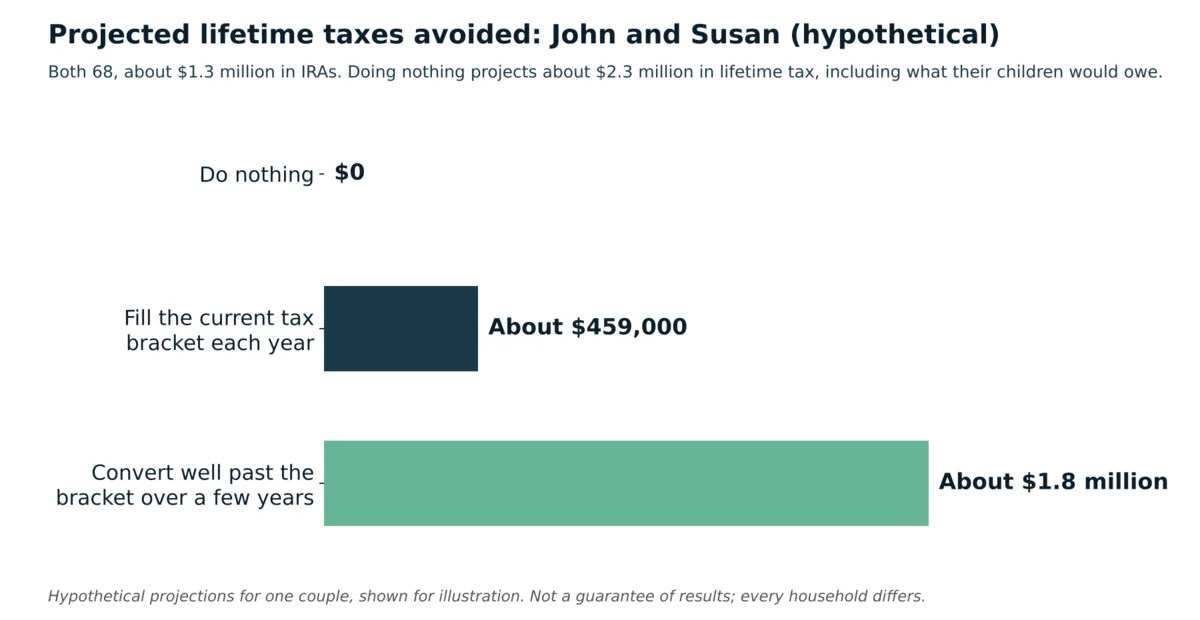
A hypothetical case: John and Susan, both 68
Craig walks through a case from one of his classes, using the names John and Susan. Both are 68, with about $1.3 million in their IRAs. The figures below are projections for this one couple, shown for illustration only.
| Strategy | Projected lifetime taxes avoided (hypothetical) | Projected tax owed by their children |
|---|---|---|
| Do nothing | $0 (about $2.3M in lifetime tax, including what the children would owe) | About $900,000 |
| Fill the current bracket each year | About $459,000 | Most of the original bill still remains |
| Convert nearly the whole IRA, well past the bracket, over a short period | About $1.8M | $0 (the inheritance is in a Roth account) |
Hypothetical illustration. Not a guarantee of future results.
Filling the bracket avoided a real chunk of tax, but most of the $2.3 million bill was still sitting there. Whatever John and Susan didn’t pay while both were alive would land first on the surviving spouse, then on the children.
The plan that protected the family most looked uncomfortable at first. Converting well past the bracket raised their tax bill for a few years and pushed their Medicare premiums higher for a while. Then the conversions ended, and their taxes and premiums dropped back down. Paying more up front avoided more than $1 million beyond the bracket-filling plan.
What to do instead in your 60s
Converting everything isn’t right for everyone. Convert too much when your situation doesn’t call for it, and your family can end up worse off than if you’d done nothing. The point is that the current bracket shouldn’t be what decides the amount.
- Run several conversion amounts side by side, not just the bracket-filling amount.
- Measure each one by what is left for you, your spouse and your children at the end, not by this year’s tax bill alone.
- Use the years before RMDs begin. RMDs start at age 73 for people born from 1951 through 1958, and at 75 for those born in 1960 or later.
Roth Conversions at 70 and After RMDs Start: It Is Not Too Late
By your 70s, the common belief sounds like this: “It’s too late. I should have done this in my 60s.” It usually comes with reasoning like, “RMDs have already started, the IRA is too big to fix, so I’ll just pay the withdrawal tax every year.”
We understand the reasoning. It just doesn’t hold up.
Tom and Betty
In his book Paying the Piper, Craig wrote about a couple named Tom and Betty. Tom had rolled his 401(k) into an IRA that grew past $2 million. By his mid-70s, his pension and Social Security covered nearly everything the couple needed. They needed perhaps $10,000 a year from the IRA, but their RMD was close to $100,000.
Tom’s question was simple: why did they have to take so much out? Once the numbers were run, the answer was to start Roth conversions, even in his mid-to-late 70s. His CPA was skeptical at first, then came around after running the numbers himself.
Why the math still works after RMDs start
Every dollar converted is a dollar that never shows up in a future RMD. Smaller RMDs mean:
- A smaller tax bill each year
- A better chance of keeping Medicare premiums lower, since IRMAA surcharges are based on income from two years earlier
- Less taxable money left for a surviving spouse and for children
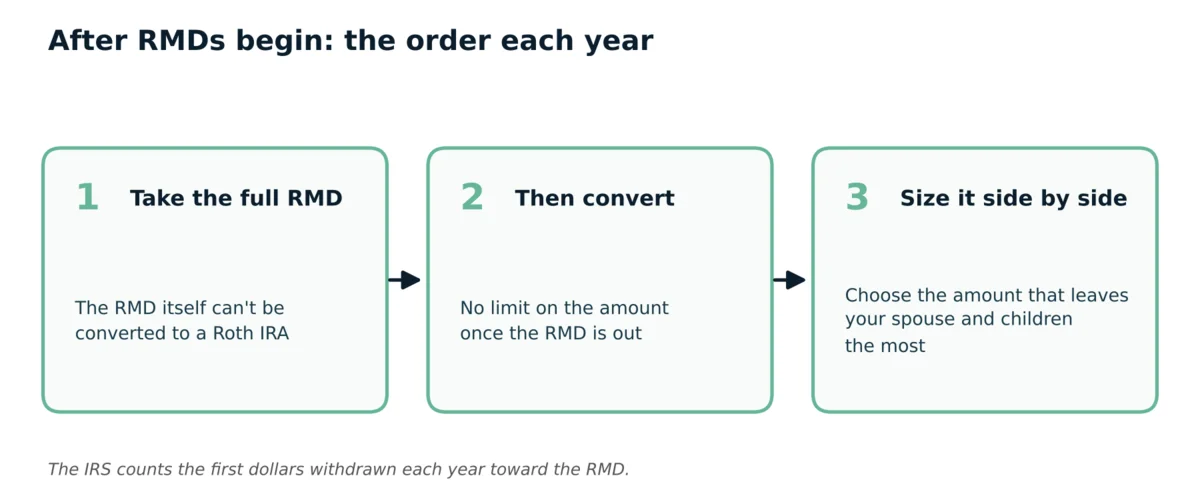
The order of operations after RMDs begin
Once RMDs have started, do it in this order:
- Take the full RMD for the year first. The IRS counts the first dollars withdrawn each year toward the RMD, and an RMD cannot be converted to a Roth IRA.
- Then convert. Once the full RMD is out, there is no limit on how much can be converted that year.
- Decide the amount with a side-by-side comparison, the same kind of comparison used for John and Susan.
If RMDs haven’t started yet, count the years you have left before they do. In that window, many people find it makes sense to convert more each year than feels comfortable at first.
Get Craig's Free Book: Paying the Piper
Craig Wear's book shows how much tax sits inside your 401(k) and IRA, and the four ways out. It's a free PDF, and we don't ask for a card.
Roth Conversions in Your 80s: Breakeven Is Only Half the Question
And in your 80s, the most common belief is this one: “A conversion won’t pay off in my lifetime, so why bother?”
On your own tax return, that may well be true. The tax is paid up front and the benefit arrives slowly, so the breakeven point may sit beyond life expectancy. That’s where most people stop thinking about conversions.
Who pays the tax that is never converted
Breakeven measures when the money comes back to you. It says nothing about the tax on everything you don’t convert, and that tax doesn’t go away. Somebody pays it, in one of three ways:
- By both spouses, through RMDs taxed at joint rates.
- By the surviving spouse, who files as a single taxpayer with brackets roughly half as wide as joint brackets. This is often called the widow’s tax trap.
- By the children, who generally must empty an inherited IRA within 10 years. That often falls during their own peak earning years or right as they plan their own retirement.
Tom’s second reason
Tom had a second reason for converting in his late 70s. He had a wife and three children, and he didn’t want to leave them a lifetime of taxes attached to the money. He chose to convert the entire IRA, more than $2 million, in a single year. That wasn’t the approach Craig recommended, since spreading it out would likely have cost less, but the reason behind it held up: the conversion was for his family, not for himself.
What to compare instead in your 80s
- Start with who will end up with the money. For most IRA owners, that is a spouse and then children.
- Compare what the family pays in total if part of the IRA is converted now versus if it is left in the IRA for the spouse and children.
- If converting leaves them more, that is the answer, whether or not it pays off on your own return.
A common response is, “My kids will be happy with whatever they get.” They probably will. But if the family can pay less tax and the heirs end up with the same amount or more, accepting the larger bill just means handing a bigger share to the IRS.

The Thread at Every Age: Your Surviving Spouse and Heirs Pay What You Don’t Convert
The three beliefs are different, but they make the same mistake. Each one looks at the IRA owner’s own numbers: this year’s bracket, their own RMDs, or their own personal payback.
The people who usually pay the most, though, are a surviving spouse and the children. A decision made only on the owner’s own return can leave most of the tax bill for the people the money was meant to help.
At every age, ask yourself who this money is really for.
Roth Conversion Mistakes to Avoid at Any Age
Across all three decades, these patterns tend to cost families the most:
- Letting a single year’s tax bracket set the conversion amount without testing larger and smaller amounts.
- Assuming RMDs end the conversion window. They change the order of operations, not the opportunity.
- Judging a conversion only by your own breakeven.
- Converting a large amount without a comparison. State taxes and Medicare premiums can each change the right number.
- Planning for one spouse instead of both, and the children after.
How Much to Convert to a Roth: Tax Brackets, IRMAA and Heirs
The same method works in every decade:
- List every source of income for the next several years, including Social Security, pensions and RMDs.
- Model at least three conversion amounts: none, bracket-filling, and a larger amount over a shorter period.
- Include the surviving-spouse years and the children’s inheritance in each projection.
- Check the Medicare premium impact for each amount.
- Choose the amount that leaves the household and the heirs with the most after tax, not the one with the smallest bill this year.
If you run your own numbers, this is often where a second set of eyes helps most. The variables interact, and a small change in one assumption can move the answer.
Roth Conversions at 60, 70 and 80: The Bottom Line
Your age changes the order of the steps, not the test. At 60, 70 or 80, a bigger tax bill for a few years is often the price of a much smaller one for your spouse and children.
About Q3 Advisors
Q3 Advisors specializes in tax-efficient retirement planning for IRA millionaires, pre-retirees and retirees. As practitioners of Rothology®, the science of Roth conversion optimization, Q3 Advisors times and sizes Roth conversions before and after RMDs begin, planning for both spouses and the children who will inherit. Q3 Advisors has worked with more than 4,000 families.
Plan Your Roth Conversion Strategy Today
The right conversion amount depends on your age, your income, your Medicare premiums and who will inherit the account, and it looks different in your 60s, 70s and 80s. A Rothology plan runs that side-by-side comparison for your household: built by our CFP® team for a one-time flat consulting fee, with annual reviews for the life of the plan. Schedule a consultation to see how your plan holds up for you, your spouse and your children.