Learning how to report a Roth conversion on taxes comes down to three documents: the Form 1099-R your custodian issues for the conversion year, Form 8606 Part II where the taxable amount is calculated, and Form 1040 lines 4a and 4b where those figures land. This guide walks the mechanics with current 2026 form references and a worked partial-basis example.
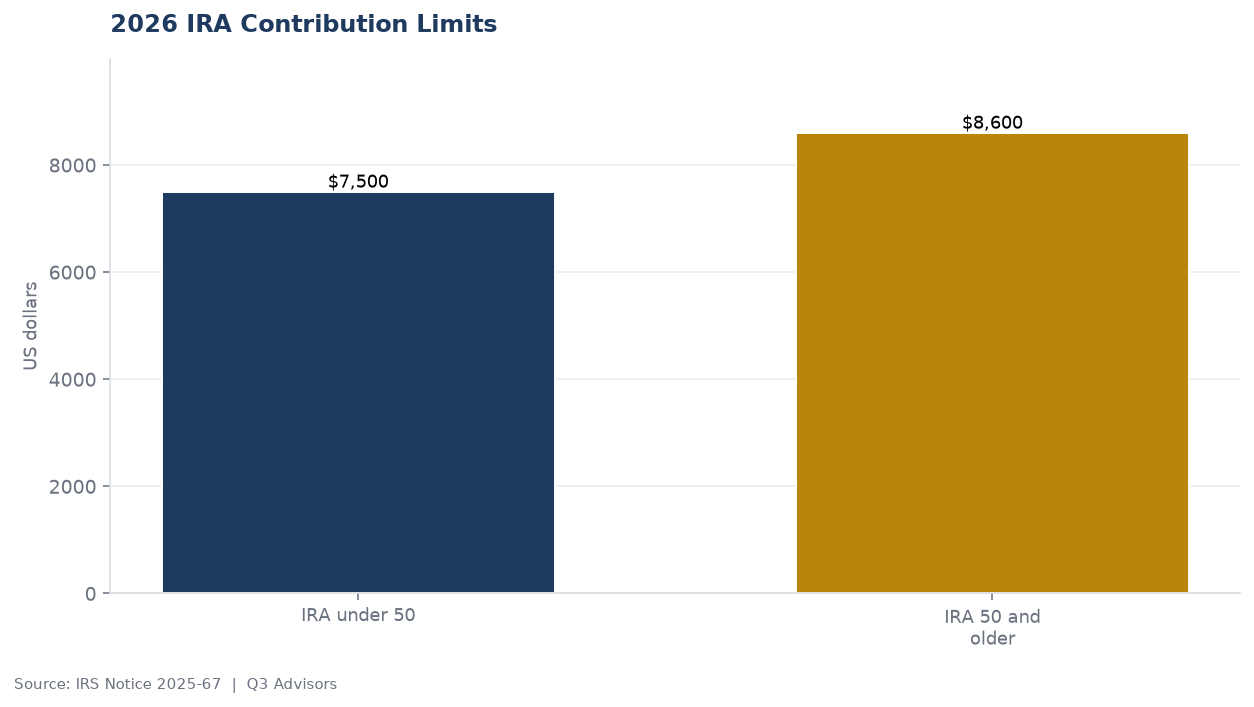
A Roth conversion is reported on Form 1099-R (issued by the custodian for the conversion year) and on Form 8606 Part II, which computes the taxable amount on line 18. That figure carries to Form 1040 line 4b, and the gross conversion goes on line 4a. The 2026 IRA contribution limit is $7,500 (Source: IRS Notice 2025-67).
Do you have to report a Roth conversion, and which forms apply?
Yes. A conversion from a traditional, SEP, or SIMPLE IRA to a Roth IRA is a reportable distribution even when the money moves trustee-to-trustee or stays with the same custodian (Source: Instructions for Forms 1099-R and 5498, 2026). Reporting runs through three forms in sequence.
Talk With Craig Wear's Team
Craig has helped IRA millionaires save over $1 million each in unnecessary taxes. Find out if a Roth conversion strategy fits your retirement, with no sales pressure and no product pitch.
- Form 1099-R from the custodian reports the gross distribution and the distribution code.
- Form 8606 Part II calculates how much of the conversion is taxable.
- Form 1040 lines 4a and 4b show the gross and taxable amounts on the return.
There is no income limit on converting. Unlike direct Roth contributions, which carry MAGI phase-outs, any taxpayer may convert a traditional IRA to a Roth IRA regardless of adjusted gross income (Source: IRS Publication 590-A, 2025). A Roth conversion is treated as a distribution followed by a rollover into the Roth, which is why the paperwork mirrors a distribution.
Start with Form 1099-R and its box 7a code
The custodian issues Form 1099-R in January of the year after the conversion, reporting the converted amount in box 1 (gross distribution) and box 2a (taxable amount), with a distribution code in box 7a (Source: Instructions for Forms 1099-R and 5498, 2026). This is the trigger document; the IRS receives a copy, so an unreported conversion is visible to them.
On 2025 and later forms, the old box 7 was renumbered to boxes 7a through 7d. Box 7a now holds the distribution code, box 7b is the IRA/SEP/SIMPLE checkbox, and boxes 7c and 7d cover other items (Source: Instructions for Forms 1099-R and 5498, 2026). Older forms label the code box simply “box 7.”
| Box 7a code | Meaning | When it applies |
|---|---|---|
| 2 | Early distribution, exception applies | Participant under age 59½ at the time of the conversion |
| 7 | Normal distribution | Participant age 59½ or older |
Code 2 signals that the custodian recognizes the conversion exception, so the 10% early-distribution tax does not attach to the conversion itself (Source: Instructions for Forms 1099-R and 5498, 2026). Box 2a from a custodian is often not reliable for pro-rata situations, which is why Form 8606 does the real math.
Custodians also send Form 5498, which reports the Roth IRA contribution created by the conversion. Form 5498 is informational, arrives in May, and is not filed with the return (Source: Instructions for Forms 1099-R and 5498, 2026).

How to report a Roth conversion on Form 8606 Part II
Form 8606 Part II is the location for the conversion. Line 16 is the amount converted, line 17 is the basis (nontaxable, after-tax dollars) applied to that conversion, and line 18 is line 16 minus line 17, which is the taxable amount (Source: Instructions for Form 8606, 2025). Line 18 is the number that drives the tax bill.
| Form 8606 line | Entry |
|---|---|
| Line 16 | Net amount converted to the Roth IRA during the year |
| Line 17 | Basis (after-tax amount) allocated to the conversion, from line 11 if Part I is completed |
| Line 18 | Taxable amount (line 16 minus line 17), carried to Form 1040 line 4b |
The IRS instruction is precise on the handoff: “If your entry on line 18 is zero or less, don’t include the result on 2025 Form 1040, 1040-SR, or 1040-NR, line 4b. Include the full amount of the distribution on 2025 Form 1040, 1040-SR, or 1040-NR, line 4a” (Source: Instructions for Form 8606, 2025). In plain terms, line 4a always shows the gross conversion; line 4b shows only the taxable slice.
The pro-rata rule and a worked partial example
When you hold any pre-tax IRA money alongside after-tax basis, the pro-rata rule decides how much of a conversion is taxable. All traditional, SEP, and SIMPLE IRAs are treated as one pool, and the tax-free percentage is after-tax basis divided by the total year-end value of that pool, and the taxable percentage is the rest (the pre-tax balance divided by that total) (Source: Instructions for Form 8606, 2025). You cannot cherry-pick only the after-tax dollars to convert.
Consider a taxpayer with a $42,500 pre-tax rollover IRA who also makes a $7,500 nondeductible contribution for 2026, then converts $7,500. Form 8606 works out as follows.
| Form 8606 line | Description | Amount |
|---|---|---|
| Line 1 | Nondeductible contribution for 2026 | $7,500 |
| Line 6 | Total value of all traditional/SEP/SIMPLE IRAs at 12/31/2026 | $42,500 |
| Line 8 | Net amount converted | $7,500 |
| Line 9 | Line 6 plus line 8 | $50,000 |
| Line 10 | Basis fraction ($7,500 ÷ $50,000) | 0.150 |
| Line 11 | Nontaxable portion of conversion ($7,500 × 0.150) | $1,125 |
| Line 16 | Amount converted | $7,500 |
| Line 17 | Basis applied (line 11) | $1,125 |
| Line 18 | Taxable amount | $6,375 |
Here $6,375 flows to Form 1040 line 4b and $7,500 sits on line 4a. Only 15% of this conversion escaped tax, even though the full $7,500 came from a nondeductible contribution, because the large pre-tax balance dilutes the basis. This partial outcome is the case that surprises people who expect a clean $0.
Reporting a normal, fully taxable conversion
When the money converted is entirely pre-tax (a typical traditional IRA funded by deductible contributions or a 401(k) rollover), the whole conversion is taxable and the basis math nearly disappears. There is no after-tax basis, so Form 8606 line 17 is $0 and line 18 equals the amount converted.
For example, converting $30,000 of a pre-tax IRA with no basis produces $30,000 on Form 8606 line 18, $30,000 on Form 1040 line 4a, and $30,000 on line 4b. Someone converting pre-tax money and expecting a tax bill does not need Part I basis calculations at all; the full amount is ordinary income for the year. Q3’s separate guide on how to pay Roth conversion taxes covers funding that bill.
Reporting a backdoor Roth conversion
A backdoor Roth is a two-step sequence: a nondeductible contribution to a traditional IRA, then a conversion of that amount to a Roth IRA. Both steps are reported. The nondeductible contribution is recorded in Form 8606 Part I (establishing basis), and the conversion is reported in Part II (Source: Instructions for Form 8606, 2025).
When the taxpayer holds no other pre-tax IRA money, the basis equals the conversion, so line 18 is $0 and no tax is due on the conversion. Two entry points confirm the treatment.
- Because the contribution is nondeductible, Schedule 1 line 20 (the IRA deduction) is left blank.
- Form 8606 Part I carries the full contribution as basis, and Part II line 17 offsets the conversion to a $0 taxable result.
The pro-rata rule applies per spouse, and each spouse files a separate Form 8606 (Source: Instructions for Form 8606, 2025). A backdoor stays clean only if the person doing it has no pre-tax IRA balance; otherwise the partial result shown earlier applies.
How the conversion is taxed: ordinary income, no early penalty at conversion
The taxable portion of a conversion is taxed as ordinary income at the taxpayer’s marginal rate, not at capital-gains rates, and the 10% early-distribution tax does not apply to the conversion itself regardless of age (Source: Instructions for Forms 1099-R and 5498, 2026). Conversion income stacks on top of wages, pensions, and other income for the year.
A separate trap catches early withdrawals. If someone under 59½ withdraws converted amounts from the Roth within the five-year period that begins January 1 of the conversion year, the 10% additional tax can be recaptured on the previously converted taxable amount, reported on Form 5329 Part I and Schedule 2 (Source: Instructions for Form 5329, 2025). The recapture applies to converted amounts withdrawn within that window; amounts left in the Roth past the five-year period fall outside the rule. Withholding taken from the conversion to cover the tax is itself treated as a distribution, so it reduces the amount that actually reaches the Roth and can interact with this five-year clock.
Because conversion income is ordinary income, it can influence other thresholds such as the Medicare IRMAA brackets, taxation of Social Security via the Social Security tax torpedo, and the net investment income tax. These interactions are frequently modeled when planning conversion size, though the specific effect depends on individual circumstances.
Timing: which year, and the split-year Form 8606 trap
A conversion is taxed in the year it is completed, not the year of any related contribution (Source: Instructions for Form 8606, 2025). A conversion finished in 2026 belongs on the 2026 return regardless of when the traditional IRA was funded.
This creates a split-year situation for backdoor contributions. A nondeductible contribution made in early 2026 for tax year 2025 is reported on the 2025 Form 8606 (Part I basis), while the conversion done in 2026 is reported on the 2026 Form 8606 (Part II). The contribution and the conversion can therefore land on two different filing years, which routinely trips up software entry and hand-prepared returns.
One rule change worth flagging: a conversion made in tax years after December 31, 2017 cannot be recharacterized (undone) back to a traditional IRA (Source: Instructions for Form 8606, 2025). The pre-2018 option to reverse a conversion no longer exists, so a completed conversion is final for the year.
How to enter a Roth conversion in TurboTax
In TurboTax, a conversion is entered in two places, and skipping the first is a common reason the software overtaxes a backdoor Roth. The general sequence for a nondeductible-then-convert scenario is described below; the exact wording of screens can change by tax year.
- Under Deductions and Credits, the Traditional and Roth IRA Contributions topic records the nondeductible traditional IRA contribution, which creates the Form 8606 basis.
- Under Wages and Income, the 1099-R topic captures the Form 1099-R as issued, including the box 7a code and the IRA/SEP/SIMPLE checkbox.
- The follow-up screens ask whether the money was converted to a Roth IRA and request the year-end value of all traditional IRAs so the software can apply the pro-rata rule.
After entry, Form 8606 in forms mode shows whether line 18 reflects the expected taxable amount. For a backdoor with no other IRA balances, line 18 is $0.
Penalties for not filing Form 8606 or not reporting
Failing to file a required Form 8606 carries a $50 penalty unless reasonable cause is shown, and overstating designated nondeductible contributions can carry a separate $100 penalty for each overstatement absent reasonable cause (Source: 26 U.S.C. § 6693(b)). Beyond the flat penalty, unreported basis means the IRS may treat later distributions as fully taxable, effectively taxing after-tax dollars twice.
Form 8606 is filed with Form 1040 by the return due date, including extensions (Source: Instructions for Form 8606, 2025). If the conversion was reported but basis was omitted, a corrected or standalone Form 8606 can generally be filed for the affected year. Missing income entirely is a larger problem, because the custodian already reported the 1099-R to the IRS.
2026 IRA figures that frame the conversion
Contribution limits do not cap a conversion, since a conversion is not a contribution, but they frame the surrounding IRA rules and the standard deduction that conversion income stacks against. The 2026 figures below come from IRS Notice 2025-67 and Rev. Proc. 2025-32.
| 2026 item | Amount | Source |
|---|---|---|
| IRA contribution limit (under 50) | $7,500 | IRS Notice 2025-67 |
| IRA contribution limit (50 and older) | $8,600 | IRS Notice 2025-67 |
| Standard deduction, married filing jointly | $32,200 | Rev. Proc. 2025-32 |
| Standard deduction, single | $16,100 | Rev. Proc. 2025-32 |
| Standard deduction, head of household | $24,150 | Rev. Proc. 2025-32 |
For readers weighing conversion size against brackets and required withdrawals, Q3 maintains related references on 2026 retirement contribution limits and required minimum distributions. These are educational summaries, not recommendations.
Work with Q3 Advisors
Q3 Advisors is a registered investment adviser focused on retirement tax planning. This article is educational and is not advice; for guidance on your own circumstances, consult a qualified tax or financial professional.
Frequently asked questions
Do I have to report a Roth conversion on my taxes?
Yes. A conversion is a reportable distribution, so it appears on a Form 1099-R the custodian sends to both you and the IRS, and it is reported on Form 8606 Part II with the taxable amount carried to Form 1040 line 4b (Source: Instructions for Form 8606, 2025). Reporting is required even when the taxable amount is $0.
What form do I use to report a Roth conversion?
Three forms work together: Form 1099-R from the custodian reports the distribution, Form 8606 Part II calculates the taxable portion on line 18, and Form 1040 lines 4a and 4b record the gross and taxable amounts (Source: Instructions for Form 8606, 2025). Form 5498 is informational only and is not filed.
Do you get a 1099-R for a Roth conversion?
Yes. The custodian issues Form 1099-R for the conversion year, reporting the amount in boxes 1 and 2a and a code in box 7a: code 2 if you were under 59½ and code 7 if you were 59½ or older (Source: Instructions for Forms 1099-R and 5498, 2026). A conversion is reportable even when done trustee-to-trustee.
How do I avoid paying taxes on a Roth conversion?
The taxable amount is fixed by basis, not by choice. Only after-tax basis reduces the taxable portion through the pro-rata rule on Form 8606, so a conversion of purely pre-tax money is fully taxable (Source: Instructions for Form 8606, 2025). A conversion of only nondeductible basis with no other IRAs can produce a $0 taxable result.
Is a Roth conversion taxed as ordinary income?
Yes. The taxable portion is taxed as ordinary income at your marginal rate, not at capital-gains rates, and no 10% early-distribution penalty applies to the conversion itself regardless of age (Source: Instructions for Forms 1099-R and 5498, 2026). The income stacks on top of wages, pensions, and other ordinary income for the year.
What happens if I don’t report my Roth conversion?
Failing to file a required Form 8606 carries a $50 penalty absent reasonable cause, and unreported basis can cause later distributions to be taxed as if fully taxable (Source: 26 U.S.C. § 6693(b)). Because the custodian already reported the 1099-R to the IRS, omitting the income itself can also trigger a notice and additional tax.
How do I report a backdoor Roth in TurboTax?
It is entered in two places: the nondeductible traditional IRA contribution under the IRA Contributions topic, which creates Form 8606 basis, and the Form 1099-R under the income section, where the follow-up screens capture that the amount was converted to a Roth. Form 8606 line 18 then shows the taxable amount, which is $0 for a backdoor with no other IRA balances.
Where does a Roth conversion go on the 1040?
The gross conversion goes on Form 1040 line 4a (IRA distributions), and the taxable amount from Form 8606 line 18 goes on line 4b (Source: Instructions for Form 8606, 2025). If line 18 is zero or less, line 4b stays empty while line 4a still shows the full distribution amount.
Sources
Instructions for Form 8606 (2025), IRS, https://www.irs.gov/instructions/i8606
Instructions for Forms 1099-R and 5498 (2026), IRS, https://www.irs.gov/instructions/i1099r
Instructions for Form 5329 (2025), IRS, https://www.irs.gov/instructions/i5329
26 U.S.C. § 6693(b) (penalties relating to designated nondeductible contributions), https://www.law.cornell.edu/uscode/text/26/6693
Topic No. 557, Additional Tax on Early Distributions, IRS, https://www.irs.gov/taxtopics/tc557
Publication 590-A (2025) and Publication 590-B (2025), IRS, https://www.irs.gov/publications/p590a and https://www.irs.gov/publications/p590b
IRS Notice 2025-67 (2026 retirement plan limits), https://www.irs.gov/pub/irs-drop/n-25-67.pdf
Rev. Proc. 2025-32 (2026 inflation adjustments), https://www.irs.gov/pub/irs-drop/rp-25-32.pdf
About the author
Disclaimer
This article is provided by Q3 Advisors for educational and informational purposes only. It is not tax, legal, or investment advice and is not a recommendation to convert, contribute, or take any specific action. Tax rules change and their application depends on individual circumstances; figures and form references are current as of July 2026. Consult a qualified tax or financial professional regarding your own situation. Q3 Advisors is a registered investment adviser; additional information is available in our Form ADV.