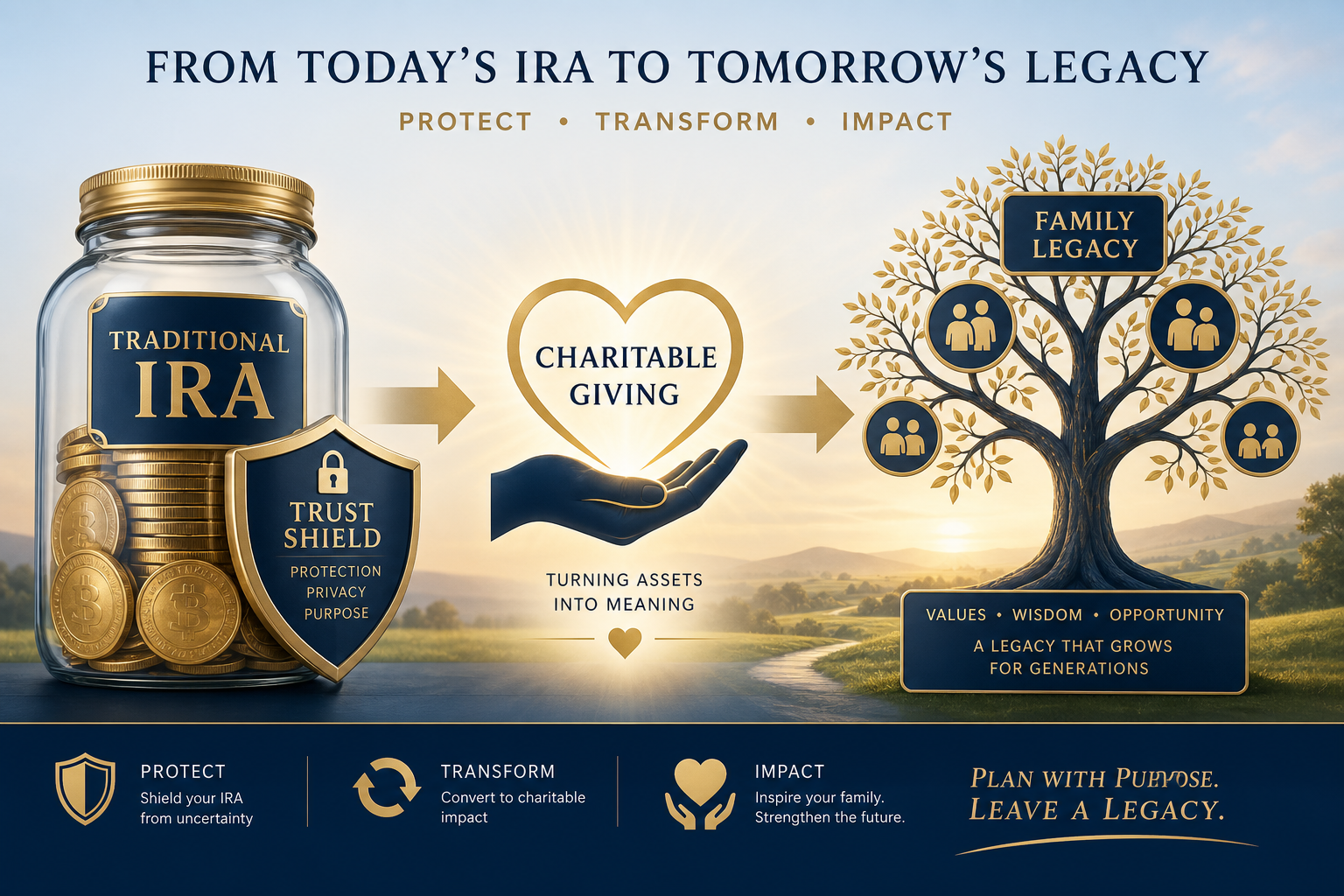
A CRT as IRA beneficiary can partly rebuild the lifetime stretch the SECURE Act ended, because the IRA flows into a tax-exempt trust under IRC 664 that pays an heir over a term up to 20 years.
Key Takeaways
- The SECURE Act of 2019 replaced the lifetime stretch with a flat 10-year rule for most non-spouse heirs, who must empty an inherited IRA by December 31 of the tenth year after death.
- A charitable remainder trust is tax-exempt under IRC 664, so the IRA flows into the trust at death with no income tax at receipt.
- A CRT unitrust payout must be at least 5 percent and no more than 50 percent of trust value, recalculated annually, over a lifetime or a term not exceeding 20 years.
- The 10 percent remainder test under IRC 664(d) requires the charity’s remainder interest to equal at least 10 percent of the amount contributed to the trust.
- The IRS 7520 rate, published monthly at 120 percent of the federal midterm rate, drives whether a young beneficiary can pass the 10 percent remainder test.
- CRT distributions follow a four-tier worst-in-first-out ordering, so IRA-funded ordinary income, taxed at 10 percent to 37 percent, is distributed first.
- The 2024 final IRS regulations, effective for 2025 forward, require annual RMDs in years 1 through 9 when the owner died after the required beginning date.
CRT as IRA Beneficiary by the Numbers
Figures cite IRS, SSA, and statutory sources as described in this article; this is educational information, not tax, investment, or legal advice.
Using a CRT as IRA beneficiary for stretch replacement is one of the few remaining ways to spread an inherited IRA across a lifetime instead of the SECURE Act 10-year window. A charitable remainder trust receives the IRA at death income-tax-free, pays the heir a stream over 20 years or a lifetime, and sends the remainder to charity. This educational guide explains the mechanism, the 2026 tax math, the constraints, and when it does and does not make sense.
A CRT as IRA beneficiary can partly rebuild the lifetime stretch the SECURE Act ended. At death the traditional IRA flows into a tax-exempt charitable remainder trust under IRC §664 with no income tax at receipt, the heir draws a 5% to 50% annual payout across a lifetime or a term up to 20 years, and the remainder passes to charity. It requires real charitable intent, a large IRA, and passing the 10% remainder test.
What did the stretch IRA used to do (and why did it matter)?
The lifetime stretch IRA let a non-spouse heir take required minimum distributions over their own life expectancy, spreading an inherited IRA across decades. A 35-year-old inheriting a $2 million IRA had a roughly 48-year distribution schedule, so first-year withdrawals were near $40,000 and stayed inside low brackets while the balance kept compounding tax-deferred.
Before 2020, the stretch produced two compounding benefits. The inherited IRA continued to grow tax-deferred for decades, often out-earning the small annual distributions. And because each year’s required distribution was modest, it rarely pushed the heir into a higher federal bracket, triggered IRMAA Medicare surcharges, or collided with the 3.8% net investment income tax. The result was an inheritance that worked quietly across an heir’s whole life rather than a tax event concentrated into a handful of high-income years, and that multi-decade spread is exactly what many families now try to recreate.
What did the SECURE Act take away?
The SECURE Act of 2019 replaced the lifetime stretch with a flat 10-year rule for most non-spouse heirs: the inherited IRA must be empty by December 31 of the tenth year after death. The freshest wrinkle is the 2024 final IRS regulations, effective for 2025 forward, requiring annual RMDs in years 1 through 9 (not just a year-10 sweep) when the owner died after their required beginning date.
That 2024 final rule is the recency point most older articles miss. If the IRA owner had already reached RMD age (73, or 75 for those born in 1960 or later, with the earliest age-75 RMD year being 2035) and died after their required beginning date, the heir cannot wait and drain the account in year 10. Annual distributions are mandatory in years 1 through 9, then the balance is fully emptied in year 10.
The compression is severe for the adult children of IRA millionaires. A $2 million traditional IRA inherited at 45 by someone already earning $250,000 forces roughly $200,000 to $250,000 of extra taxable income per year for a decade. Stacked on wages, that income routinely lands in the 32% bracket (income above $201,775 single in 2026) or the 35% bracket, plus state tax, plus the 3.8% net investment income tax and the additional 0.9% Medicare tax on earned income. Concentrating a large pre-tax balance into a single 10-year window is what pushes so many heirs into these upper brackets, which is the pressure the strategies below try to relieve.
How does a testamentary CRT recreate the stretch?
A testamentary charitable remainder trust recreates the stretch in four steps: you name the CRT as your IRA beneficiary, the full IRA flows to the tax-exempt trust at death with no income tax, the trust pays your heir a 5% to 50% annual stream over a lifetime or a term up to 20 years, and the remainder passes to charity. Because the trust is exempt under IRC §664, no 10-year deadline applies to it.
A charitable remainder trust is an irrevocable, tax-exempt trust authorized under IRC §664. Funded at death by an IRA, it is a testamentary charitable remainder unitrust (T-CRUT). The mechanics:
- Name a testamentary CRT as IRA beneficiary. The trust language lives inside your estate documents, and the IRA beneficiary form on file with the custodian names the trust or its trustee in a fiduciary capacity.
- The IRA flows to the CRT at death with no income tax. Because CRTs are tax-exempt under §664, the transfer is not a taxable event and no 10-year deadline binds the trust. The full balance is preserved and keeps compounding.
- The CRT pays your heir over a lifetime or a fixed term. Most use one or more lifetimes or a term not exceeding 20 years. The unitrust payout is at least 5% and no more than 50% of the trust value, recalculated annually.
- The remainder passes to charity. When the term ends or the beneficiaries die, whatever remains passes to the named charity, often a donor-advised fund or family foundation the family still influences.
The structural edge over the 10-year payout: the trust pays no entity-level income tax, so IRA assets compound without annual tax drag for the whole term, and the heir’s yearly taxable income is far smaller than the bunched distributions the SECURE rule forces.
How are the CRT payments to your heirs actually taxed?
CRT distributions are taxed under a four-tier “worst-in-first-out” (WIFO) ordering in Treasury regulations under IRC §664. Payouts carry out the trust’s highest-taxed income first: ordinary income, then capital gains, then other (tax-exempt) income, then return of principal. Because a traditional IRA funds the trust entirely with ordinary income, the heir’s payments are taxed as ordinary income for many years before any lower-rate tier is reached.
This tier system is a commonly overlooked point in most CRT explainers, and it materially changes the heir’s effective rate. The IRS treats the pre-tax IRA dollars that entered the trust as a large reservoir of ordinary income, and under WIFO distributions must exhaust that ordinary-income tier before any capital-gain or principal treatment applies. An heir is unlikely to see a blended or low-rate result in the early years.
| Tier | Character of income | 2026 tax treatment |
|---|---|---|
| Tier 1 | Ordinary income (the IRA dollars sit here) | Taxed at ordinary rates, 10% to 37%; distributed first until exhausted |
| Tier 2 | Capital gains realized inside the trust | Long-term gains 0% / 15% / 20%; reached only after Tier 1 is gone |
| Tier 3 | Other income (for example tax-exempt interest) | Taxed per its own character; rarely reached with an IRA-funded CRT |
| Tier 4 | Return of trust principal | Tax-free; typically the last dollars out |
The practical takeaway: for an IRA-funded CRT, most or all of an heir’s early payments are ordinary income. The distinction is not a lower character of income, it is the spreading of that ordinary income across up to 20 years or a lifetime, so each year’s taxable slice is smaller than the bunched distributions the SECURE rule forces into a single decade.
Worked example: a $2M IRA inherited at 35, CRT vs. the 10-year rule
On a $2 million traditional IRA inherited at 35, a testamentary CRUT spreads ordinary income across up to 20 years while the SECURE 10-year payout concentrates it into a decade. The CRT’s structural edge is a smoother income schedule and tax-free compounding inside the trust; its trade-offs are a charitable remainder of roughly 30% to 50% and mortality risk if the heir dies early.
Assume the owner dies in 2026, the IRA is $2 million, and the heir is 35. The comparison below is illustrative and structural, describing how each path works rather than projecting any result.
| Feature | SECURE 10-year payout (direct to heir) | Testamentary CRUT (5% payout, 20-year term) |
|---|---|---|
| IRA balance at death | $2,000,000 | $2,000,000 |
| Income tax at IRA receipt | None (deferred) | None (CRT is tax-exempt) |
| Distribution period | 10 years | 20 years |
| Character of heir’s income | Ordinary | Ordinary first, under WIFO |
| Compounding during the payout | Taxed once distributed to the heir | Trust assets compound tax-free under §664 |
| Charitable remainder | None | Passes to charity, subject to the 10% minimum test |
| Early-death risk | Remaining balance passes to the heir’s estate | Undistributed assets go to charity, not the family |
| Irrevocability | Heir controls the inherited IRA | Trust terms are fixed once the owner dies |
A CRT is not designed to maximize family wealth. It trades some family value for a smoother income schedule and a charitable result, and if the heir dies early the undistributed assets pass to charity rather than the family. Whether the structure fits depends on the heir’s age, the payout rate, the charitable goal, and how long the income stream is expected to run, all of which an adviser and estate attorney model together before any drafting.
Where the CRT contributes structurally: payments land across up to 20 years including the heir’s lower-income retirement years, and the assets compound tax-free inside the trust rather than in a taxable brokerage account taxed on dividends and gains every year. Many families fund a life insurance policy on the heir from part of the income stream, a wealth-replacement overlay that can restore the charitable remainder for the next generation. For larger IRAs ($5 million or more) and longer beneficiary life expectancies, the income-spreading feature has more years to work with.
What is the 10% remainder test, and why does it constrain young beneficiaries?
The 10% remainder test under IRC §664(d) requires the present value of the charity’s remainder interest to be at least 10% of the amount contributed to the trust. The calculation uses IRS actuarial tables and the §7520 interest rate at funding. A 5% payout to a very young lifetime beneficiary often fails, because actuarially so little is projected to remain for charity.
For testamentary CRTs naming young heirs, this test is usually the binding constraint. The longer the beneficiary’s expected lifetime, the smaller the projected remainder, and a lifetime payout to a 30-year-old at 5% can drop below the 10% floor. Getting the test wrong voids qualification under §664 and erases every tax benefit, so these trusts require an estate-planning attorney with CRT modeling software.
How the §7520 rate changes the math
The §7520 rate, published monthly by the IRS at 120% of the federal midterm rate, directly drives the test. A higher §7520 rate produces a smaller present value for the income stream, which leaves a larger present value for the charitable remainder and makes the 10% test easier to pass. Designing or funding the trust in a higher-rate environment helps a young beneficiary qualify.
20-year term, lower payout, or joint or older lives as fixes
When a young-beneficiary CRT falls below the 10% line, three design levers commonly bring it back into qualifying range. Each one shortens the projected income period or reduces the payout, leaving a larger actuarial remainder for charity. A drafting attorney typically models all three together, since the right combination depends on the beneficiary’s age, the payout rate, and the §7520 rate at funding.
Three levers commonly bring a young-beneficiary CRT back over the 10% line:
- Use a 20-year fixed term instead of a lifetime payout. A term interest is capped at 20 years and often passes where a young life-only payout fails. This is the most common workaround.
- Lower the payout rate toward the 5% floor. A 5% unitrust leaves more for the remainder than a 7% or 8% payout, at the cost of less annual income to the heir.
- Add older or joint lives. Naming parents alongside children, or older joint beneficiaries, shortens the actuarial payout period and can satisfy the test.
When does this strategy make sense?
Naming a CRT as IRA beneficiary tends to make sense when several conditions align: a traditional IRA of roughly $1 million or more (often $2 million-plus), non-spouse heirs who would face high marginal rates during the 10-year window, genuine charitable intent, a long enough beneficiary life or term to capture the spread, and comfort with irrevocability once the owner dies.
Many families consider the strategy when the heir would otherwise absorb bunched distributions at 32% to 37% federal rates plus state tax, which fits adult children in their 40s and 50s with established careers. Below roughly $1 million, drafting and administration costs consume too much of the benefit. Charitable intent is not optional: the remainder to charity is real, so this suits only families that genuinely want to give, often after years of Roth conversion strategy have already shrunk the pre-tax balance.
When does it NOT work?
A CRT as IRA beneficiary does not fit spouses, eligible designated beneficiaries, families without charitable intent, sub-$1 million IRAs, or heirs in states that tax CRTs. Surviving spouses keep the lifetime stretch through a spousal rollover. Eligible designated beneficiaries (minor children of the owner, disabled or chronically ill people, and anyone less than 10 years younger) already keep a stretch and need no CRT.
- Spousal beneficiaries are almost always better served by a spousal IRA rollover, which preserves the survivor’s own lifetime stretch. SECURE did not change spousal rollover rules.
- Eligible designated beneficiaries under SECURE, including the owner’s minor children, disabled or chronically ill individuals, and beneficiaries less than 10 years younger than the owner, retain a lifetime or life-expectancy stretch directly, so the CRT is unnecessary.
- Families without charitable intent give up meaningful value to charity, even with a life insurance overlay, and often find the direct payout a better fit.
- Modest IRA balances under about $1 million generally cannot support the legal and administrative overhead.
- Hostile-state CRT taxation. A small number of states do not fully honor the federal tax-exempt status of charitable remainder trusts, or tax trust or beneficiary income in ways that erode the advantage. Pennsylvania, for example, has historically treated CRTs differently from the federal rules, and several states tax trust income based on the trustee’s or beneficiary’s residence. Where the heir or trust is taxed in one of these states, modeling the after-state-tax result before committing matters, because it can meaningfully narrow or erase the federal benefit.
How does this coordinate with a multi-year Roth conversion plan?
A testamentary CRT may work well as the final layer of a multi-year Roth conversion arc, not in isolation. During the pre-RMD years the owner converts traditional IRA dollars to Roth at controlled bracket levels, shrinking the pre-tax balance. At death, the Roth passes to heirs tax-free under the 10-year rule while the residual traditional IRA funds the CRT for stretch replacement, capturing both advantages.
The sequencing for a typical IRA-millionaire arc runs in three stages. In the pre-RMD years between retirement and RMD age (73, or 75 for those born in 1960 or later), the family converts traditional balances to Roth by filling lower brackets. Deciding how much to convert to Roth each year and tracking your Roth conversion break-even keeps the plan disciplined, and every conversion must clear the December 31 Roth conversion deadline because a conversion cannot be undone.
In active retirement, conversions continue where the math still works, complemented by qualified charitable distributions from an IRA once the owner reaches 70½. Coordinating conversions with 2026 required minimum distributions matters here, since a conversion cannot come from an RMD and the RMD itself is always taxable. At death, the residual traditional IRA flows to the testamentary CRT and the Roth passes directly to heirs tax-free, capturing both advantages, which can produce a strong multi-generational outcome for families with charitable intent.
Work with Q3 Advisors
Q3 Advisors is a registered investment adviser focused on retirement tax planning. This page is educational and is not advice; consult a qualified professional.
Frequently asked questions
Can a charitable remainder trust replace a stretch IRA?
A charitable remainder trust can partly replace the stretch IRA the SECURE Act ended. Naming a testamentary CRT as IRA beneficiary lets the trust receive the IRA tax-free at death and pay an heir a stream over a lifetime or a term up to 20 years, recreating the multi-decade spread. It is not a perfect substitute, because a charitable remainder must ultimately go to charity.
Does a charitable remainder trust pay income tax on IRA distributions?
No, at the trust level. A charitable remainder trust is tax-exempt under IRC §664, so the IRA distribution into the trust at the owner’s death triggers no income tax at receipt. Income tax is paid by the non-charitable beneficiary as payments are received over the term, with the ordinary income spread across many years rather than concentrated into a single 10-year window.
What is the 10% remainder test for a charitable remainder trust?
The 10% remainder test under IRC §664(d) requires that the present value of the charity’s remainder interest be at least 10% of the amount contributed to the trust, using IRS actuarial tables and the §7520 interest rate at funding. Trusts naming young lifetime beneficiaries often fail it. Common fixes are a 20-year fixed term, a lower payout rate, or adding older or joint lives.
Can you name a trust as the beneficiary of an IRA?
Yes. You can name a trust, including a testamentary charitable remainder trust, as the beneficiary of an IRA by listing the trust or its trustee on the IRA custodian’s beneficiary form. For a CRT, the trust must qualify under IRC §664 and the drafting must satisfy the 10% remainder test. Because the rules are technical, most families use an estate-planning attorney experienced with charitable trusts.
How are distributions from a charitable remainder trust taxed?
Distributions follow a four-tier “worst-in-first-out” ordering under IRC §664. Payments carry out the trust’s highest-taxed income first: ordinary income, then capital gains, then other income, then tax-free return of principal. Because a traditional IRA funds the trust entirely with ordinary income, an heir’s payments are taxed as ordinary income for many years before any lower-rate tier is reached.
What is the difference between a CRAT and a CRUT?
A charitable remainder annuity trust (CRAT) pays a fixed dollar amount set at funding and cannot accept additional contributions, so payments never change. A charitable remainder unitrust (CRUT) pays a fixed percentage (5% to 50%) of the trust value recalculated annually, so payments rise and fall with the trust’s value and can grow over time. Testamentary IRA-funded plans typically use a CRUT for that flexibility.
Is a charitable remainder trust subject to the 10-year rule?
No. The SECURE Act 10-year rule applies to non-spouse individual beneficiaries of an inherited IRA, not to a charitable remainder trust. Because a CRT is tax-exempt under IRC §664, the IRA can pay into the trust without the 10-year deadline, and the trust then distributes to the heir over a lifetime or a term up to 20 years. That is precisely why the CRT can recreate a stretch-like schedule.
How much goes to charity with a charitable remainder trust?
The charitable remainder must be worth at least 10% of the contribution at funding, and in practice it often ends up between 30% and 50% of the original IRA, depending on the payout rate, beneficiary age, term length, investment returns, and the §7520 rate. Families who want to restore that value for heirs frequently fund a life insurance policy from part of the trust’s income stream.
Putting this into a larger plan
A testamentary CRT is one of the few tools that can recreate a stretch-like schedule under current law, but it often pairs well with a Roth conversion strategy that has run for years before death. Lifetime conversions shrink the traditional balance, the CRT spreads whatever remains, and the Roth passes to heirs tax-free, which can produce a strong multi-generational result for families with genuine charitable intent.
Q3 Advisors is a registered investment adviser focused on Roth conversion strategy, retirement tax planning, and legacy coordination for families with large IRAs. Our planning models the multi-decade tax picture across generations, including how testamentary CRTs interact with lifetime conversions and the broader estate plan. To see how the pieces fit a specific situation, you can read more from Craig Wear, CFP®, or contact our team.